
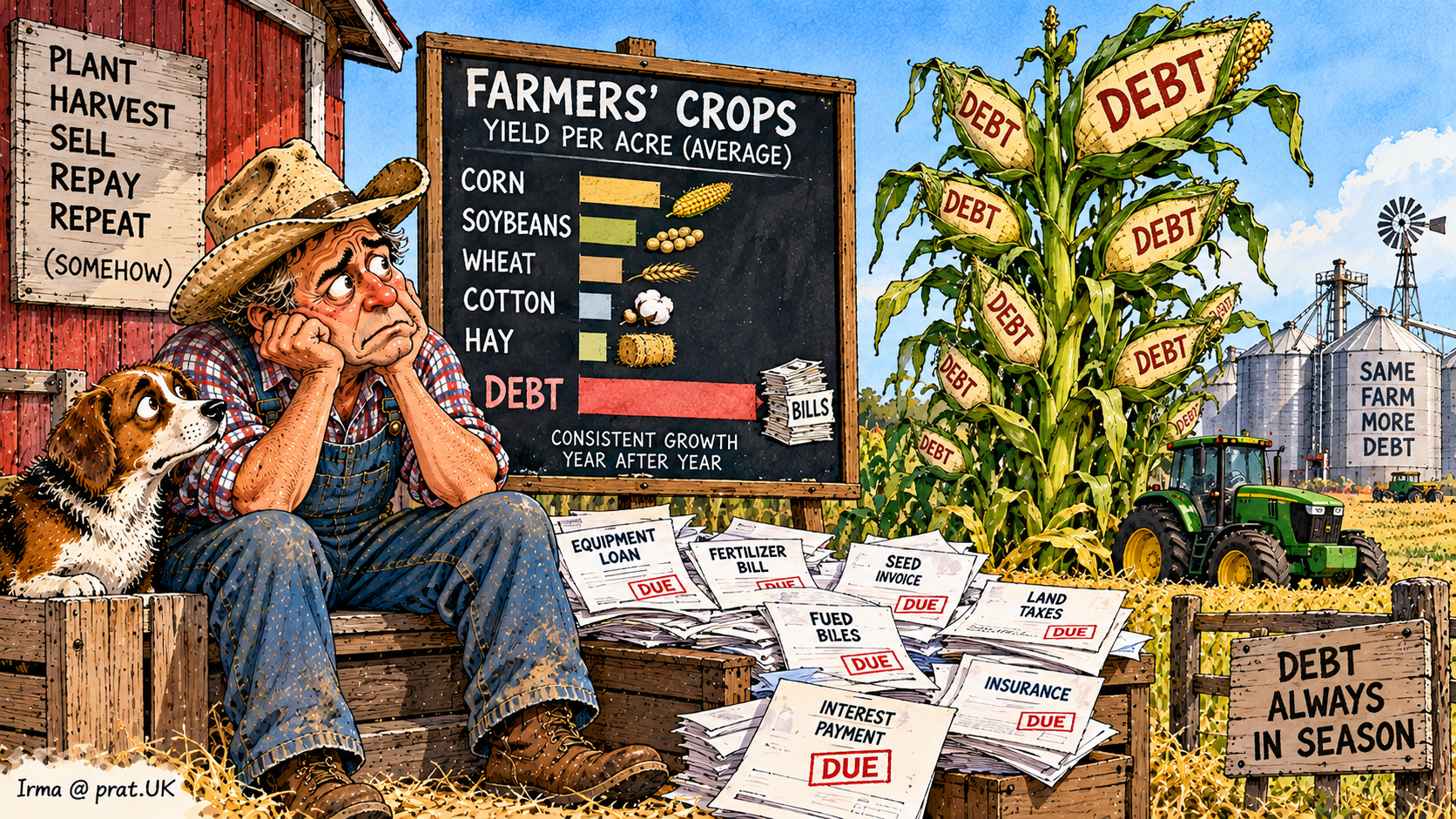
It requires no fertilizer and survives drought
LINCOLN, NEBRASKA – American farmers have spent generations attempting to improve yields through better seed, advanced machinery, irrigation technology and scientific research. Now, federal economists have identified the one agricultural product that grows reliably regardless of rainfall: debt.
The USDA forecasts that total farm-sector debt will reach $605.1 billion in 2026, an increase of $26.4 billion over 2025. Unlike corn, debt requires no fertilizer. Unlike soybeans, it survives drought. Unlike cattle, it doesn’t need feeding. And unlike almost everything else farmers produce, its price is rarely discussed in terms of how little the buyer can afford to pay.
Financial experts believe debt may soon become America’s leading agricultural commodity, particularly if economists begin counting the paperwork.
Agriculture Discovers the Perfect Crop
The conventional farming business model contains a serious economic flaw: Farmers must spend money before they know whether they will earn any. Seeds cost money. Fertilizer costs money. Insurance costs money. Equipment repairs frequently cost an amount normally associated with elective surgery.
After paying these expenses, farmers wait for weather, commodity prices and circumstances entirely beyond their control to determine whether the operation was worthwhile. By contrast, a lender can finance the entire adventure and collect interest regardless of whether the corn grows.
Professor Calvin Compound, an economist whose doctorate was allegedly awarded by the First National Bank of His Own Imagination, calls it a magnificent agricultural innovation.
“We’ve separated the profit from the uncertainty,” Compound explained. “Unfortunately, we left the uncertainty with the farmer.”
He recommends planting debt at 7% interest and harvesting it monthly.
USDA Farm Income Forecast Shows Negative Median Farm Earnings
The USDA farm income forecast contains a remarkable statistic: Median income earned from farming among farm operator households is projected at approximately negative $467 for 2026.
That is not total household income, which commonly includes substantial earnings from jobs outside the farm. But it remains an impressive occupational achievement. Most Americans work to earn money. Many farmers work to lose money while holding another job to finance the experience.
A public opinion survey asked 500 urban consumers whether they would accept an occupation involving long hours, physical danger, weather dependence, substantial debt and potentially negative earnings. Four respondents expressed interest. Three believed the question described journalism. The fourth already owned a dairy farm.
Congress Announces a New Agricultural Success Metric
Under a proposed government accounting system, farmers would no longer measure success in bushels per acre. Instead, performance would be evaluated using borrowed dollars per tractor, interest payments per chicken and the number of bank executives who smiled during the annual loan review.
The highest-performing farmer would receive a commemorative plaque reading “Outstanding Contribution to Regional Banking.” The plaque would remain the property of the lender until the award recipient completed 36 monthly payments.
Economists predict that this approach could transform agricultural lending into the most dependable harvest in American history.
Farmers Demand Recognition for Their Achievements
American agriculture has increased productivity through generations of ingenuity. Farmers feed millions, manage vast acreages, raise livestock and operate equipment more complicated than some commercial aircraft.
Yet their greatest financial achievement may be keeping the entire system operational while working capital, commodity prices and borrowing expenses play musical chairs.
A Nebraska farmer summarized the situation during a county agricultural forum.
“My grandfather grew corn. My father grew wheat. I grow concerned.”
He subsequently applied for an operating loan to cover the cost of his concern. The bank approved it. Apparently, the concern was excellent collateral.
The Evidence File
Definitions of Key Terms
Debt, n.: the only farm commodity that is never in surplus, never stored in a bin and never discounted at harvest. Its basis is always positive, which is more than can be said for the household income figure above.
Cost-Benefit Analysis
If a farmer carries the sector’s average share of that $605.1 billion at 7% interest, the interest alone arrives faster than the corn does. A bank earns on a schedule. A farmer earns on a prayer and a commodity board. The Pro Farmer analysis of the 2026 farm profit outlook puts the hope in writing, and the numbers do the rest.
False Authority
Gerald Mortgage, a self-proclaimed Dean of Agricultural Leverage, informed a local rotary club that “the farm of the future will own nothing and be financed by everything.” He is currently looking for a venue willing to book him a second time.
Sources and Further Reading
See the USDA ERS farm income forecast highlights, the RFD-TV report on solvency, and the Farm Credit Administration at fca.gov for lender oversight.
Source: USDA Economic Research Service, September 2026 forecast of farm debt, household earnings and farm-sector income.
Humorous Observations
- “Unlike corn, debt survives drought.” It’s the only crop in America where a flood is also considered growth.
- Negative $467 median income from farming. You could take that number to a Vegas casino and call it a good night.
- Three people thought the job description described journalism. And honestly, they weren’t wrong about the pay.
- A commemorative plaque that belongs to the bank until you finish 36 payments. That’s not an award. That’s a lease on your own dignity.
- “My grandfather grew corn. My father grew wheat. I grow concerned.” Somebody should print that on a feed cap and sell it back to him at a premium.
Last Updated on October 27, 2026 by Alan Nafzger