
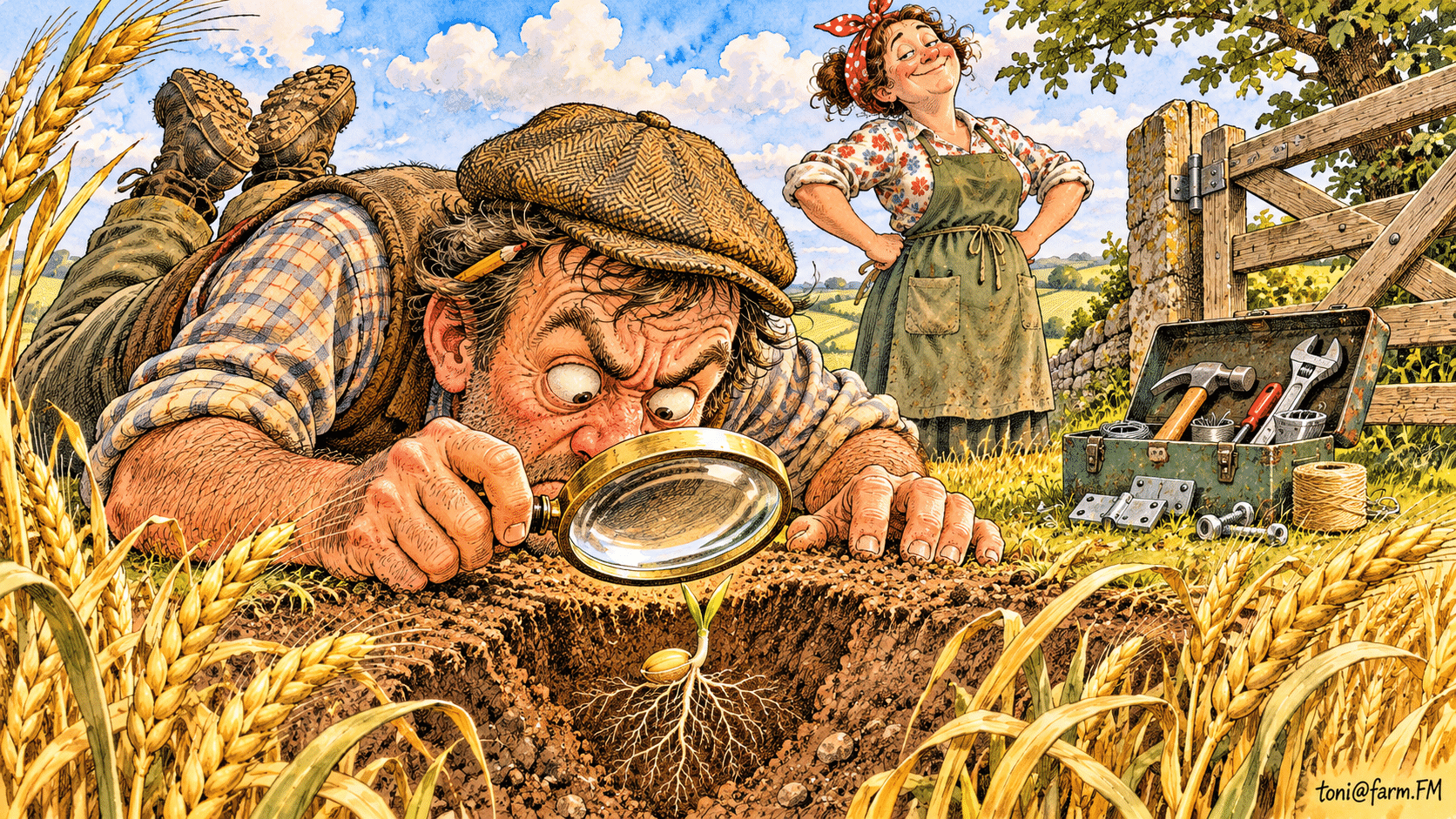
Winter wheat emergence has received so much personal attention from farmer Earl Ransom that his wife has asked whether the seed might perform better without being dug up for a progress interview.
Ransom says he is checking development. His wife, Patricia, says most things develop more comfortably without a man interrupting them with a pocketknife every afternoon.
“I’m not bothering it,” Earl said. “I’m establishing communication.”
Winter Wheat Emergence Meets the Anxious Parent
Recent coverage of state winter wheat emergence illustrates an important distinction: a low percentage does not automatically mean an unusual delay. Planting calendars and historical averages differ among states. Conditions and the date of the report matter.
Ransom initially interpreted every national number as a personal evaluation. If wheat emerged somewhere else, he felt his own seed owed him an explanation.
His agronomist, Owen Shaw, pointed out that planting, germination and visible emergence are separate stages. A completed planting job is not the same as a completed stand. Moisture, temperature, planting depth and seed condition all influence the result.
Earl said he had completed his part on a Tuesday and would appreciate similar professionalism from the wheat.
The Seed Declines Another Status Meeting
The field now receives morning visits, afternoon visits and special visits prompted by Earl thinking about it while doing something unrelated.
Patricia has proposed a visitor limit. Earl objected that the farm was private property. She replied that the seed seemed to be making the same argument.
At the café, a neighbor announced he could see green from the road. Earl drove home using a route that allowed him to inspect the neighbor’s field, then spent twenty minutes considering whether the green might be weeds.

Shaw suggested inspecting his own stand methodically and recording useful observations. He did not recommend conducting a countywide contest in suspicious squinting.
The farmer has taken several phone photographs. In one, a tiny green point appears beside his boot. Earl calls it encouraging emergence. Patricia calls it a photograph requiring the purchaser to supply his own wheat.
Patience Is Not Sold by the Bag
The household’s unofficial poll found strong support for adequate moisture, appropriate temperatures and Earl finishing the broken gate before starting another plant interview.
Shaw advised using local Extension guidance to assess a stand, checking conditions and seeking help when establishment looks poor. Automatically assuming a crop has failed can be as unhelpful as automatically assuming it is fine. A distant headline cannot diagnose a particular field.
Earl has agreed to reduce unnecessary disturbance. He will keep records, inspect at sensible intervals and allow underground activities to continue without supervision.
Patricia says this may be his greatest contribution to root development.
He still stands at the field edge, however, explaining that the family has invested considerable resources and would welcome a sign of commitment.
By evening, more green was visible. Earl credited his encouragement. Shaw credited the conditions. Patricia said both men were welcome to discuss causation after the gate was repaired.
The wheat offered no statement.
For the first time all week, Earl respected its decision to remain focused on the job.
Satirical disclaimer: No wheat seed was required to attend a status meeting. Our ceremonial human collaboration pairs two sentient beings—the world’s oldest tenured professor and a philosophy major turned dairy farmer—who remain available to argue about the underlying evidence.