
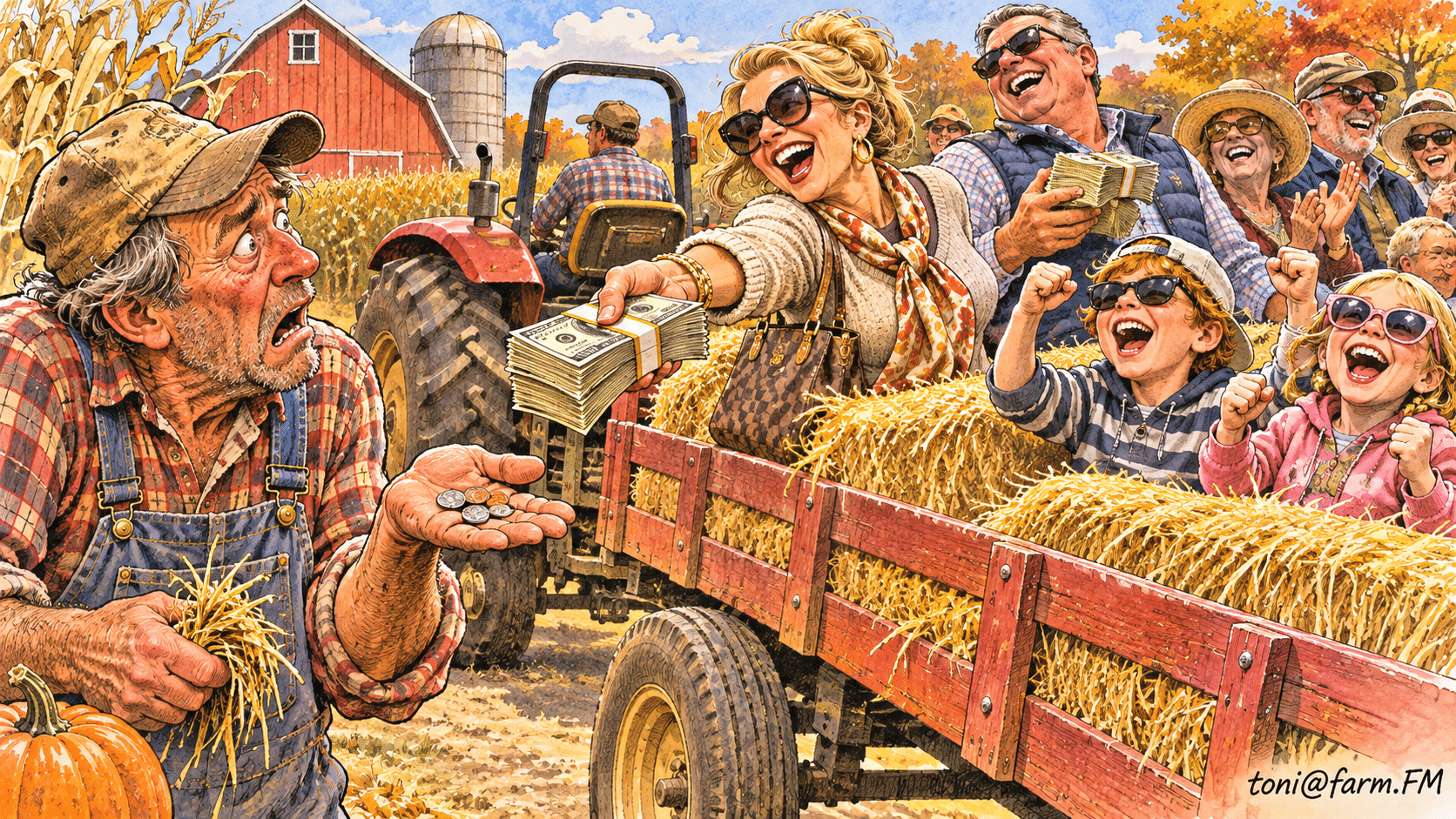
AMARILLO, Texas. The most successful breakthrough in American agriculture this fall appears to be charging strangers to sit on hay. As The Guardian reports on family farms turning to agritainment, commodity prices are stagnant while visitor experiences help pay the bills. The hay, previously employed as livestock feed, has secured a promotion into hospitality.
The farm agritainment hayride business model begins with one observation: a cattleman purchasing hay asks for a discount, but a tourist purchasing twenty minutes on the same hay requests a photograph and a commemorative beverage. Both people sit near cattle. Only one gets charged admission.
The Luxury Hay Economy
County economist Buck Wheeler presented his findings at the diner using two objects: a bale and a velvet rope. Without the rope, the bale was forage. With the rope, it became an experience. Add a plaid blanket, and the local banker suddenly wants a business plan instead of collateral.
“I used to get complaints that my hay was coarse,” said one unnamed farmer, brushing straw out of his hair. “Now customers tell me it feels authentic.” He is considering adding a surcharge for the bale that still smells like a cow.
Three Observations Nobody Put in the Farm Budget

First, farmers have spent generations eliminating discomfort from machinery while vacationers pay to experience it voluntarily. Second, a tractor pulling a hay wagon is entertainment, but a tractor pulling a baler is an expensive problem. Third, the same customer who won’t pay an extra dime for bread will pay handsomely to explain farming to a child who thinks the combine runs on Wi-Fi.
A deliberately unscientific survey of six diners found that all six would pay more for a hayride if it ended with pie. One suggested the hay also receive a tip. The waitress immediately asked whether the hay intended to split it.
Real Evidence, Ridiculous Conclusion
Real data do give the joke a backbone. The USDA Economic Research Service counted $1.26 billion in 2022 U.S. farm and ranch agritourism income, up 12.4% from 2017 after inflation. This is revenue, not proof that every hayride makes money. Insurance, staffing, toilets, parking and weather remain capable of eating a profit before the cows do.
The farmer’s practical advice is to track the visitor business separately from the hay operation. His less practical advice is to name each bale after a famous resort and charge for the view. The cows have already filed a complaint that their dinner now has better upholstery than their barn.
At closing time, the cash register was full, the wagon was empty, and the hay remained unsold in the traditional sense. The farmer gazed toward the manure pile and wondered whether it, too, might qualify as an immersive experience.
Related Farm.FM Agritainment Stories
Explore more Farm.FM satire about corn maze agritourism and goat petting zoos.
Editorial Disclaimer
These comic farm characters and diner surveys are satire. The story is an entirely human collaboration between two sentient beings: the world’s oldest tenured professor and a philosophy major turned dairy farmer.